Directly editing a VLA's weights improved its performance, with no fine-tuning
I ran the π0.5 DROID policy on two manipulation tasks in simulation. Opus 5.5 analysed why it fails at sorting blocks and fixed it by changing its weights directly. No training and no fine-tuning: four attention heads were turned up 3×. Sorting went from 9 to 27 successes out of 30, and a second task the edit was never designed for got better too.
Setup
The policy is the public pi05_droid_jointpos checkpoint, used exactly as released. Both tasks run in Isaac Sim with a Franka arm, a Robotiq gripper and DROID's two cameras, one over the shoulder and one on the wrist. Objects are placed slightly differently in every episode.
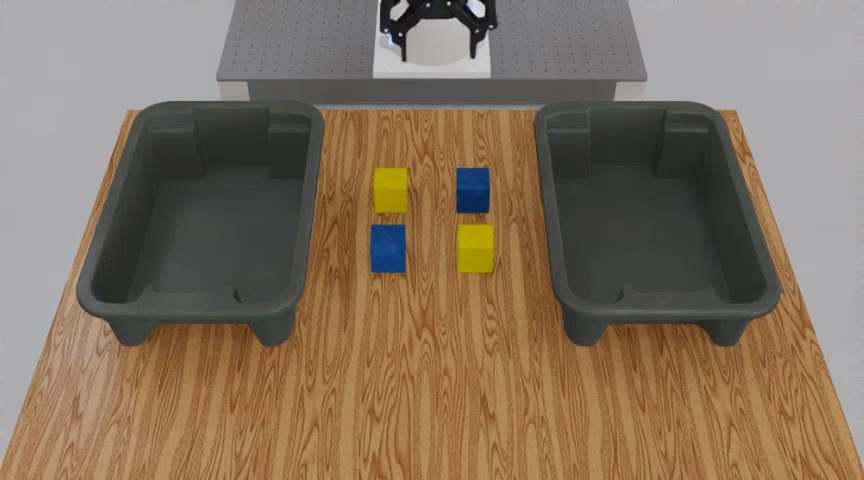
“Put the blue blocks in the right bin and the yellow blocks in the left bin.”
- Objects
- 4 blocks, 2 movable bins 10.5 cm tall
- Success
- every block in its own bin
- Time limit
- 120 s
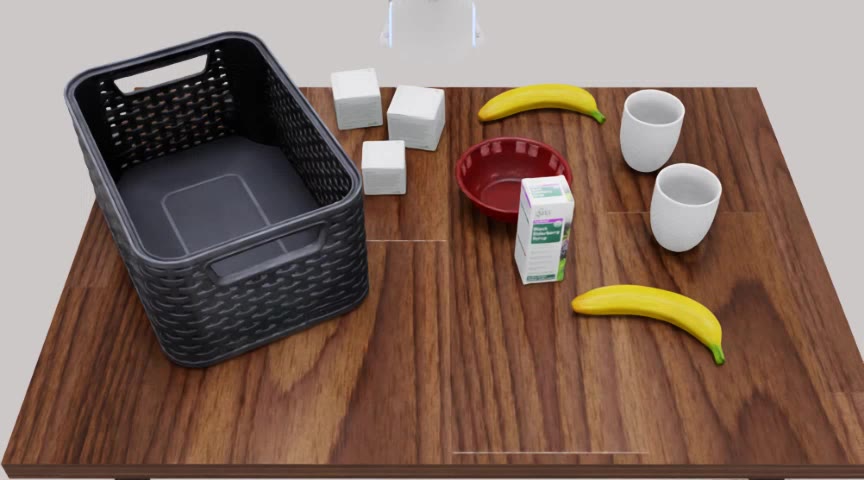
“Put both white cups into the basket.”
- Objects
- 2 cups, a basket, 7 other objects
- Success
- both cups in the basket
- Time limit
- 60 s
The process
- 1Run the original modelon both tasks
- 2Diagnose Task 1watch the failures, measure what goes wrong
- 3Edit the weightsusing Task 1 only
- 4Run the edited modelon both tasks, same 30 placements
The edit was designed using only the colour-sorting task. The cups task played no part in it and was only measured at the end. All before and after results in the Results section come from 30 object placements per task that were not used while designing the edit.
Who did what
- Me
- Set the question, chose the two tasks, decided to focus on sorting, and reviewed the results.
- Opus 5.5
- Watched the failures and found the cause, designed and ran every experiment, chose the four heads, edited the weights, and ran the before and after tests. It made the edit by writing and running code that tried candidate changes and applied the one it chose.
Results
Task 1 · Colour sorting
| Colour sorting · 30 episodes | Before | After |
|---|---|---|
| Successful episodes | 9 | 27 |
| Blocks sorted, average out of 4 | 2.9 | 3.9 |
| Episodes with a bin knocked off | 16 | 0 |
| Typical time of a successful episode | 40 s | 31 s |
Task 2 · Cups in basket
This task was not used at all while designing the edit; it was run at the end only to check nothing broke. It improved instead. Cups are carried higher, as with the blocks, and episodes finish sooner. The gain is smaller than on Task 1.
| Cups in basket · 30 episodes | Before | After |
|---|---|---|
| Successful episodes | 20 | 27 |
| Average episode time | 44 s | 32 s |
| How high cups are carried (typical) | 23.5 cm | 28.6 cm |
| Episodes where the robot grabbed another object | 12 | 12 |
The robot still sometimes picks up a white box instead of a cup; the edit does not change that.
How Opus 5.5 found the fix
The problem: blocks are carried too low
Opus 5.5 first checked whether the model mixes up the colours. It doesn't: when both bins are on the table it puts almost every block in the right one. The real failure is mechanical. The robot carries the block low, the gripper catches the rim of the bin, and the arm drags the whole bin off the table. After that the task can't be finished.
So the fix is simple to state: carry the block higher, without changing how the robot grasps.
The fix: four “lift higher” dials
π0.5 is built from many small parts called attention heads, 288 of them in total. Each one adds its own small contribution to the robot's next move.
- 1Test each headOpus 5.5 turned each head off, then doubled it, and measured one thing: how high the robot carries the block.
- 2Find the dialsFour heads act like a dial. Turn them down and the carry drops; turn them up and it rises. Grasping stays the same.
- 3Turn them upMultiplying all four by 3 raises the carry by about 2.3 cm on average, which lifts most carries clear of the rim. In the full tests no bin was knocked off in 30 episodes.
| Four heads turned up | Carry height | Grasp height |
|---|---|---|
| ×2 | +1.4 cm | no change |
| ×3 (used) | +2.3 cm | no change |
| ×4 | +3.0 cm | starts to change |
Measured while designing the edit, on recorded inputs from the original model. The test results are in the Results section above.
This changes 1.57 million of the model's 3.35 billion weights. The edited model is saved as an ordinary checkpoint and runs with the standard code, with no extra hooks at inference. The tests show what these heads do to the robot's movement; why the model computes it this way internally is a separate question.
Where the edit lives in π0.5
π0.5 is two connected transformers. A large one (2B parameters) reads the camera images, the instruction and the robot's joint positions. A small one (300M, the “action expert”) reads what the large one produced and outputs the next second of movement. Each has 18 layers with 8 heads per layer. Two of the edited heads are in each.
Limits
- One scene per task, in simulation. Other scenes and a real robot are untested.
- The edited model sometimes puts a blue block in the wrong bin: 4 blocks across its 3 failed sorting episodes. The original rarely did this while both bins were on the table.
- Opus 5.5 found the heads by testing many candidates against one measurement, not by guessing in one shot.