Editing GR00T's weights tripled its colour sorting ability, with no fine-tuning
In my last write-up, Opus 5.5 fixed π0.5's colour sorting by editing four attention heads. This time I gave it the same experiment on a different robot policy, NVIDIA's GR00T N1.7, and it ran the whole thing on its own. GR00T fails for a different reason: it puts blue blocks in the wrong bin. Opus 5.5 traced that to two attention heads and turned them up 3×. No training and no fine-tuning: sorting went from 4 to 12 successes out of 30. Unlike with π0.5, the edit has a cost: grasps got slightly less precise, and a second task got worse.
Setup
The policy is the public GR00T-N1.7-DROID checkpoint, used exactly as released. Everything else matches the π0.5 study: Isaac Sim, a Franka arm, a Robotiq gripper and DROID's two cameras, one over the shoulder and one on the wrist. Objects are placed slightly differently in every episode; for colour sorting and the seven extra tasks, the placements are the same as in the π0.5 study.
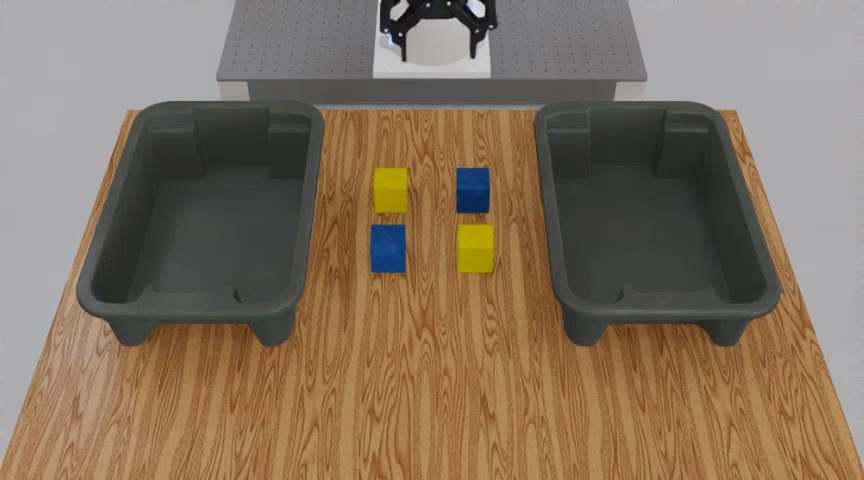
“Put the blue blocks in the right bin and the yellow blocks in the left bin.”
- Objects
- 4 blocks, 2 movable bins 10.5 cm tall
- Success
- every block in its own bin
- Time limit
- 120 s
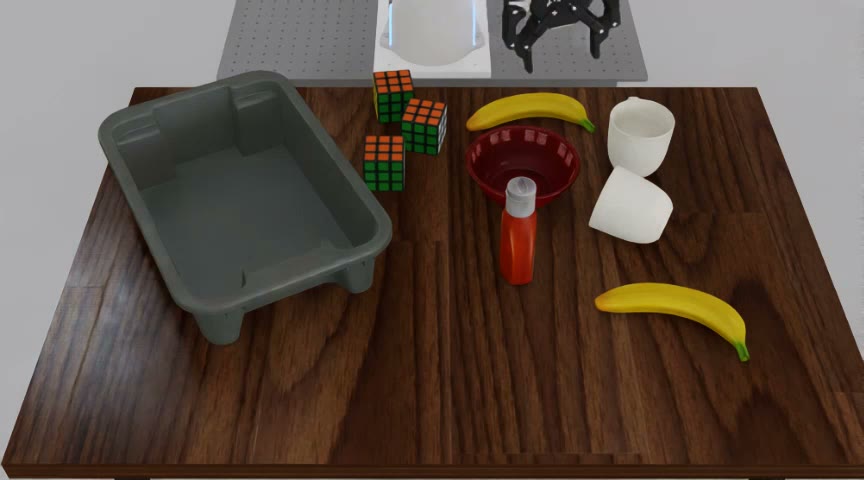
“Put the two white mugs in the grey bin”
- Objects
- 2 mugs, a bin, 7 other objects
- Success
- both mugs in the bin
- Time limit
- 60 s
The second task differs from the π0.5 study: its cups-in-basket scene was replaced by RoboLab's mugs-in-bin task, which has the same goal.
The process
- 1Run the original modelon both tasks
- 2Diagnose Task 1watch the failures, measure what goes wrong
- 3Edit the weightsusing Task 1 only
- 4Run the edited modelon both tasks, same 30 placements, then on seven more tasks
The edit was designed using only the colour-sorting task. The mugs task played no part in choosing it and was only checked for harm. All before and after results come from 30 object placements per task that were not used while designing the edit.
Who did what
- Me
- Set the question, chose to repeat the π0.5 experiment on GR00T, and reviewed the results.
- Opus 5.5
- Everything else, on its own from start to finish: set up GR00T, ran the original model, found the cause of the failures, chose the two heads, edited the weights, ran the before and after tests and wrote up the results. It had the edit chosen and frozen within five hours of starting.
Results
Task 1 · Colour sorting
| Colour sorting · 30 episodes | Before | After |
|---|---|---|
| Successful episodes | 4 | 12 |
| Blocks sorted, average out of 4 | 2.1 | 2.9 |
| Blocks put in the wrong bin | 21 | 0 |
| Episodes with a bin knocked off | 1 | 0 |
The edited model still fails 18 of 30 episodes, mostly in a different way that both models share: after one or two blocks the arm hovers with the gripper open and never grasps again. The edit doesn't touch that.
Task 2 · Mugs in bin
This task played no part in choosing the edit. It got worse: the edited model didn't finish a single episode.
| Mugs in bin · 30 episodes | Before | After |
|---|---|---|
| Successful episodes | 5 | 0 |
| Mugs in the bin, average out of 2 | 0.70 | 0.37 |
| First grasps that hook the mug | 20 | 23 |
| Time with a mug stuck on the gripper, per episode | 9.7 s | 15.0 s |
Hooked mugs were already the original model's main failure here. The edit makes it more frequent; the reason is in the next section.
How Opus 5.5 found the fix
The problem: “right bin” barely registers
π0.5 failed at sorting because it carried blocks too low and caught the bin rims. GR00T doesn't: it carries high and places cleanly. Its failure is the destination. In the original model's tests, 21 blocks went into the wrong bin, and every one of them was a blue block going left.
Opus 5.5 replayed the moment each carry starts through the model with different instructions, and read off which bin the arm heads for:
| Instruction given | Blue goes left |
|---|---|
| The task's: blue → right bin, yellow → left bin | 53% |
| Swapped: blue → left bin, yellow → right bin | 99% |
| Only “Put the blue blocks in the right bin.” | 58% |
48 recorded carry starts, each with 4 different random seeds.
So GR00T understands colour: told to put blue on the left, it does so 99% of the time. What's weak is the word “right”. Even an instruction that only says “right bin” sends blue left more than half the time. The fix to aim for: make “right bin” count, without changing anything else.
The fix: two “right bin” dials
- 1Test each layerOpus 5.5 turned each layer's attention off, then doubled it, and measured one thing: which bin the arm heads for. Two late layers of the language model, 12 and 13, moved it the most consistently, in both directions.
- 2Find the dialsInside those layers, two heads act like a “right bin” dial: turn them down and blue goes left more, turn them up and it goes right.
- 3Turn them upMultiplying both by 3 sends blue to the correct bin in 95% of the recorded moments. In the full tests, not one block went to the wrong bin.
| Two heads turned up | Blocks headed to the correct bin | Other movement changed by |
|---|---|---|
| ×1 (original) | 76% | – |
| ×2 | 92% | 1.6 cm |
| ×3 (used) | 95% | 2.6 cm |
| ×4 | 98% | 3.7 cm |
Measured while designing the edit, on recorded inputs from the original model. “Other movement” is how far the arm's planned movement shifts at moments before a grasp, where the bin shouldn't matter. The test results are in the Results section above.
This changes 524,288 of the model's 3.46 billion weights. The edited model is saved as an ordinary checkpoint and runs with the standard code, with no extra hooks at inference.
The side effect
The two heads don't only carry “right bin”. Turned up 3×, they shift the gripper about half a centimetre toward the robot's right and slightly higher in general. Carrying blocks to a bin doesn't care about that. Grasping a mug by its rim or picking up a banana does: the edited model closes its gripper a few millimetres off and hooks the mug or misses the banana more often.
Where the edit lives in GR00T
GR00T is a vision-language-action model with two parts. A vision-language backbone (the first 16 layers of NVIDIA's Cosmos-Reason2 2B) reads the camera images and the instruction. An action head, a diffusion transformer with 32 layers, turns the backbone's output and the robot's state into movement. Both edited heads are in the backbone, which has 16 heads per layer.
Seven more tasks
As with π0.5, I then ran the edited model, unchanged, on seven more tasks from RoboLab's benchmark, with the same 30 placements per task as in the π0.5 study.
| Successful episodes · 30 per task | Before | After |
|---|---|---|
| Pick up the banana and place it in the bowl | 29 | 23 |
| Put the onion in the wood bowl | 2 | 5 |
| Put the serving bowl on the shelf | 0 | 1 |
| Stack the yellow block on the red block | 0 | 0 |
| Put the bagels on the plate | 0 | 0 |
| Put the green spoons in the pot | 0 | 0 |
| Throw away the apple | 0 | 0 |
| All seven tasks (out of 210) | 31 | 29 |
Level overall. The onion and the shelf improved a little; banana got worse, almost all of it missed grasps from the same small shift. The other four tasks were 0 for both models. On π0.5, the same kind of edit carried over: those seven tasks went from 46 to 73 successes.
Limits
- Simulation only, one scene per task. A real robot is untested.
- The edit removes the wrong-bin failure, but sorting still fails 18 of 30 episodes, mostly because the arm stops grasping after one or two blocks.
- Unlike the π0.5 edit, this one does not carry over to other tasks, and it makes precise grasps slightly worse.
- The second task is mugs in a bin instead of the π0.5 study's cups in a basket, so that comparison is not like for like.
- Opus 5.5 found the heads by testing many candidates against one measurement, not by guessing in one shot.